
‘This is going to be the hardest thing I ever do in my life, is walking out these doors. The good thing is, I’ll only be across the street.’
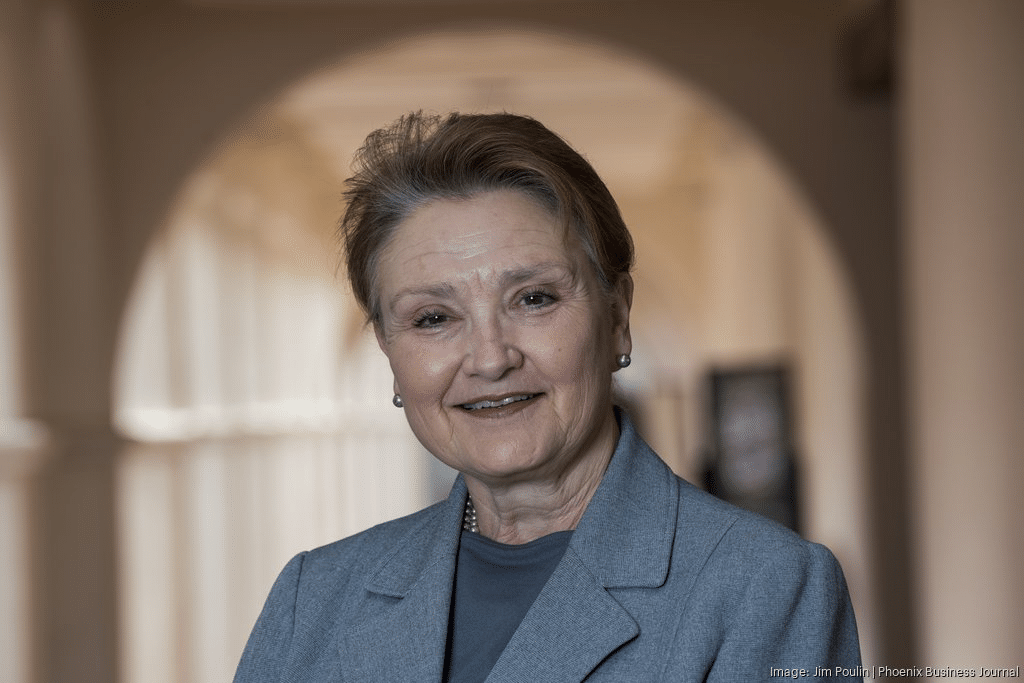
Early on in her storied career in economic development, Christine Mackay recalls that one of her first big projects was bringing an MCI call center to the Valley. In a sign of the times, workers there were inquiring about providing service for long distance phone calls.
Mackay says she remembers it like it was yesterday.
“Those were the types of jobs we were going after. You were trying to bring in thousands of jobs at a time, because we were growing so quickly, you had to ensure that you were just bringing in jobs,” Mackay recalls. “You weren’t thinking about the types of jobs you were bringing in.”
What a difference 28 years makes.
These days, economic development officials in the Phoenix metro are reeling in multibillion projects such as Amkor’s semiconductor chip packaging and testing facility in Peoria and Taiwan Semiconductor Manufacturing Co.’s massive campus in north Phoenix.
Mackay has played a huge role in the area’s growth over the past decade as the city of Phoenix’s community and economic development director, and before that, in a similar role in Chandler. She’ll continue to be a prominent figure moving forward, as the Greater Phoenix Economic Council announced Aug. 28 that Mackay will be their next president and CEO.
Of course, Phoenix didn’t make the leap to an advanced manufacturing powerhouse overnight. In the early 2000s, everybody was happy “as long as people were building things and city coffers stayed full,” Mackay said. But when the Great Recession hit in the latter part of that decade, market values in Valley municipalities were crushed.
“In Chandler, we went from issuing 2,000 building permits a month to one in February of 2009,” Mackay said. “So, that’s how hard we got hit.”
What does Phoenix want to be when it grows up?
The Great Recession was a wake-up call. Economic development leaders banded together and committed to a strategy of diversifying the economy. As a result of that shared vision, “Phoenix is faring better than virtually any big city across the country,” Mackay said.
In her new role, Mackay will be responsible for keeping that momentum going.
It’s a challenge she’s eager to tackle. She said what’s most exciting about her new role is the opportunity to work with cities throughout the Valley to answer a vital question together: “What is it that metro Phoenix wants to be when it grows up?”
Mackay opened up during an Aug. 28 interview with the Business Journal about her new role with GPEC, the hardest part about leaving Phoenix and her proudest accomplishment over the past decade.
The following conversation has been edited for brevity and clarity.
When did the possibility of taking on this role crystalize for you? It was about the same time that Chris Camacho announced that he was leaving. And so I was very fortunate that I kind of started to think about what the opportunities could be working for such an amazing organization .. Chris called to let me know he was leaving, and it was something that that just kind of popped into my head.
Is there anything more you can say about what that conversation was like, what [Camacho] said about the role, what he warned you about, what he prepared you for? You know, we haven’t had that conversation yet. I called him, and first thing I did was I called him and said ‘traitor,’ because he was leaving to go to the private sector. That’s the truth. Chris and I’ve been together for 17 years, so I called and told him he was a traitor, which made him laugh. And then I congratulated him on his new role. We really didn’t talk much about the position or what could be expected, or anything like that. It was more of just a congratulations to Chris on his ability to move forward.
Obviously you’ve had years of practice with economic development in Phoenix. What attributes do you think will translate, and what attributes might you have to learn in this different role? So in Chandler, a much smaller city, a suburban city, [I was] working with high tech manufacturers and building malls and doing different things like that. I Came to Phoenix 11 years ago and kind of got thrust into building; I had never built a high-rise in my life. This is a 517-square-mile city, so we can fit eight to 10 of most of the other cities in the region, just in this city. So when I came to Phoenix, it was a real eye-opener. At 517 square miles, we have 15 urban villages, and each one’s got its own personality. And in the beginning, it really took my breath away. I came from a 71-square-mile city to a 517-square-mile city. … This morning I woke up and went, ‘Oh my gosh, now I’m going from 517 square miles to more than 3,000 square miles.’ So I think those skills are going to translate, but I think what i’m looking forward to the most kind of jumping off is meeting with all the cities and understanding what’s important to them, where they’re going and where they’re moving.
I know it’s always difficult to leave a work family, but how hard was it? It’s so hard! I haven’t left them yet; I’m still sitting here with them. I’m here with them until October 10. I will tell you, this is the hardest thing I have ever done in my life, is leaving my role in the city of Phoenix. This is a bold city. It is a city manager who trusts his department directors, and he’s got a good and guiding hand. He’s got a rope around your waist, so he lets you go out just as far on the ledge as you can go to bring the right things back. But if you if you start to fall over, he pulls you right back really quickly. And a City Council who trusts us, and we work closely with the council. I feel so connected. I was at a community meeting in Laveen last night, and I got in my car and I got choked up because it dawned on me that’s probably the last time I see these people that I see every quarter. This is going to be the hardest thing I ever do in my life, is walking out these doors. The good thing is, I’ll only be across the street.
What ultimately tipped the balance towards taking on this new challenge? I came from Chandler, and back then when you cut me, I bled Chandler colors. I never thought I would leave Chandler. And I was offered this opportunity in Phoenix, and got to come to Phoenix and learn so many different things in the city of Phoenix, and take so many different risks and so many different challenges. What kind of tipped the scale was the opportunity to get to work with all 21 of the other economic development directors across the region, and being able to maybe help make a difference. It was such an exciting opportunity that just made sense.
What developments that you were part of with in Phoenix are you most proud of? I have one that I am singly most proud of, and that’s Park Central. And I know everybody thinks I should say TSMC. But it’s Park Central, and the reason being, that’s a mall I used to go shopping at when I was a kid. My mom worked there. We’d get dropped off there and then ride home with my mom. And there was a pet store in the ground floor, the basement of Park Central. And back then you could buy a skunk, you could buy an alligator, you could buy a raccoon, you could buy a monkey. It was just a different time. That was the first place I remember shopping … and then the mall went into absolute disrepair. When I started here in Phoenix, I’m on the 20th floor, and I look east and north out my window — all the high rises you see today weren’t built. I had a direct view of Park Central. I’m like, ‘What economic developer worth their salt is letting that thing languish?’ It’s right on light rail, it’s in the central city. And I started to look into it. I met with ownership, and you start to find all the reasons that it languished for 20 years. So we learned so much, and I’m so proud of being on a team that was kind of pioneering how you revitalize these urban malls.
What ongoing developments make it the hardest to depart your job? So my single hardest one is the revitalization of the old Kmart at I-17 and Northern. We are turning it into a workforce and education collaborative in partnership with ASU and Maricopa Community Colleges and Northern Arizona University and West-MEC and Washington Elementary School District. We’ve been working on this for five years. We bought the building. First the cleaning out of the old Kmart, and then the construction will start on it in September. So I’ll at least be here to see the construction start, but for me that project is such a point of pride for me. … There’s so many. I typed up the list of everything, it’s like 100-long of things that I have to make sure somebody’s picking up and carrying forward.